From My Head to My Body: Rethinking Anxiety

For most of my life, I lived in my head.
Thoughts, analysis, replaying conversations, preparing for futures that had not happened—that was my natural habitat. If you had asked me how I felt, I would have told you what I was thinking. I did not know there was a difference.
Anxiety, for me, was never a tight chest or a racing heart. It was a spiral of what-ifs. A loop of worst-case scenarios. A mind that would not stop.
The Cultural and Professional Roots of Living in My Head
Some of this came from my background. Growing up in an Asian household, there was a certain way of approaching life. Be prepared. Anticipate what could go wrong. Plan ahead. The worst-case scenario was not something to fear—it was something to prepare for. This was not pessimism. It was how you stayed safe, how you avoided failure, how you honoured the sacrifices that had been made for you.
This way of thinking followed me into my professional life. I trained and worked in finance. My world was built on analysis, scenario planning, and forecasting. I was taught to evaluate risk, to model outcomes, to prepare for different possibilities. This was not just a job—it was a way of seeing the world. Things could be anticipated. Things could be planned for. If I thought about it enough, I could stay ahead of it.
In that framework, the body did not feature much. The body did not analyse. The body did not plan. The body was just the vehicle that carried my mind from one task to the next. I did not see it as a source of information. I saw it as something to manage—or, more often, to ignore.
I believed that once I cleared my thoughts, action would follow, and things would work out. My emotions were not important. My body was only worth noticing when it forced me to stop—when I was sick, exhausted, or overwhelmed.
The Struggle to Notice
It was not until I started therapy training that I began to pay attention to my body in a different way. Even then, it felt distant. Abstract. I knew I was supposed to notice sensations. I knew it mattered. But I did not really get it. The body felt like a foreign language I was only beginning to learn.
So I started paying attention. Slowly. Awkwardly. Not because I suddenly believed it would help, but because my training kept asking me to. I trusted the process more than I trusted my own resistance.
At first, I could only name one thing: a tightness in my chest. That was clear. That was obvious. I had felt it before—I just had not called it anything.
Beyond that, I was lost. Butterflies in my stomach? I did not know what that meant. I did not feel it. Or maybe I did, but I could not name it. The body felt like a language I did not speak.
There was one other thing I could name: tense shoulders. I did not notice them myself—not really. But I had a masseur who once said to me, with genuine curiosity, "What kind of job do you do? Your shoulders are so tense." That stayed with me. Someone else saw something in my body that I could not see in myself.
Here is what confused me: I did not think of these sensations as anxiety. They felt like stress. The weight of work. The pressure of life. The tension of holding things together. Anxiety, in my mind, was something else—something more dramatic, more obvious. A panic attack. A spiral of fear. Not this quiet, constant tightness.
Anxiety Has Three Elements
This is what I have come to understand: anxiety is made up of three elements.
Physical sensations. The tight chest. The tense shoulders. The racing heart. The shallow breath. These are the body's responses.
Emotions. The feeling of fear. The sense of dread. The unease that sits beneath the surface.
Thoughts. The spiral of what-ifs. The worst-case scenarios. The mind's stories about what might happen.
For years, I was aware of the thoughts. I knew about the emotions—vaguely, distantly. But the physical sensations? I did not notice them. I did not connect them to anything. They were just background noise.
Through therapy training, I started to understand that the physical element is not separate from anxiety—it is part of it. The body is not just carrying the anxiety. The body is experiencing it, often before the mind even knows what is happening.
The Internal Mechanism: Emotion Before Thought
Here is something I learned that shifted my understanding.
The brain does not wait for conscious thought to react. It scans the world constantly, matching patterns. When it detects something familiar—a tone of voice, a situation, a memory—it responds immediately. This happens in the amygdala, the part of the brain that processes emotion and threat. The response is fast. Faster than thought.
By the time the conscious mind catches up, the reaction is already running. The body has already tightened. The heart has already quickened. The feeling is already there.
In neuroscience, this is called the "cognitive gap"—the tiny moment where the brain begins to respond before conscious thought arrives. The reaction happens so quickly that we are not even aware of it until after it has started.
This means that anxiety does not start with thoughts. It starts with a pattern match—a recognition of something that feels familiar, something that once meant danger. The body and the emotions react first. The thoughts come later, trying to explain what is happening.
When Anxiety Becomes a Problem
It is human to feel anxious. Some anxiety is part of our survival kit—it keeps us alert, prepared, and aware. The internal mechanism that drives anxiety was once serving us well. It was trying to keep us safe.
But sometimes that mechanism gets stuck in overdrive. It keeps firing even when the original threat is no longer present. The same pattern match that once protected us now triggers a response that is stronger than the situation calls for.
When anxiety is out of control, it can become as disabling as any chronic physical illness. The high emotional arousal switches off the rational brain. Thinking becomes black and white, all or nothing. It is hard to see clearly, to assess risk accurately, to respond rather than react.
This is not a sign that something is wrong with you. It is a sign that the system is working too hard—stuck in a pattern that no longer serves you.
The Human Givens Psychotherapy Frame
Human Givens offers a helpful way to understand this.
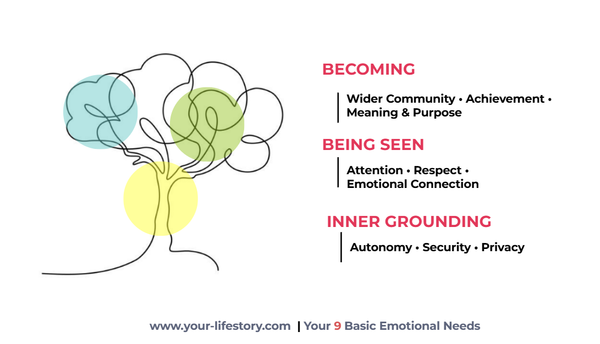
When anxiety is out of control, it often means something in our lives is out of balance. We all have emotional needs—safety, connection, autonomy, meaning, rest. When one or more of these needs is not being met, the nervous system becomes alert. It signals that something is not right.
Anxiety is that signal.
The same physiological arousal can show up in different situations. The racing heart before a difficult conversation feels similar to the racing heart before meeting someone you love. The difference is not in the body—the body does not distinguish between the two. The difference is in the story we tell ourselves about what is happening.
One story creates anxiety. The other creates excitement or anticipation.
So where does anxiety come from? The body is not giving it to you. The body is giving you a signal—a sensation. Your mind is interpreting that signal. Your mind is the one deciding what it means.
This is where pattern matching comes in. The brain recognises something familiar and responds before you have time to think. The story you tell yourself about what is happening is often shaped by old patterns—things that happened before, things that felt unsafe, things that once required you to be on guard.
Rethinking the Body's Signals
This changed something for me.
I started to wonder: what if my tight chest was not always anxiety? What if it was just my body getting ready for something that mattered? What if the story I was telling myself was making it heavier than it needed to be?
The body is not the enemy. It is not trying to ruin your day. It is not a sign that something is wrong with you.
The body is just responding. It is tightening because it cares. It is alerting because something matters. It is preparing you—sometimes too much, sometimes too often, but always because it is trying to protect something.
The aim is not to eliminate anxiety. That is neither possible nor desirable. Anxiety is part of being human. The aim is to manage it—to learn to work with it so it functions the way it was intended: to our benefit, not to our detriment.
Practical Guidance: Working with the Three Elements
If anxiety has three elements—physical sensations, emotions, thoughts—then we can work with all three.
Noticing Physical Sensations
When anxiety shows up, the body reacts first. The chest tightens. The breath becomes shallow. The shoulders tense up.
The first step is simply to notice this. Not to judge it. Not to try to stop it. Just to recognise it. "My chest is tight. My breath is fast."
This simple noticing creates a small pause—a moment where choice becomes possible.
Calming the Amygdala
When anxiety is high, the emotional brain is in charge. The rational brain is offline. One of the most effective ways to calm the system is to soothe the amygdala—the part of the brain that triggers the alarm.
Deep breathing helps. Slow, intentional breaths signal to the nervous system that there is no emergency. Creating space—stepping away, pausing, giving yourself a moment—also helps. These small actions tell the body that it can settle.
Working with Thoughts
Once the body has begun to settle, the mind can start to work differently. Instead of spiralling into worst-case scenarios, you can ask yourself different questions. "What is happening right now? What is my body telling me? What story am I telling myself about this?"
The goal is not to force positive thinking. The goal is to create enough space to see the situation more clearly—to notice that the story you are telling yourself is not the same as the situation itself.
Working with Emotions
Emotions are not the enemy either. They are signals too. When you feel fear or dread, it is worth asking: what is this emotion trying to tell me? What in my life feels unsettled?
This is where the Human Givens frame is helpful. If anxiety is a signal that a need is not being met, then the next question is: which need? Safety? Connection? Autonomy? Meaning? Rest?
Identifying the need is the first step toward addressing it.
Where I Am Now
I still notice the tightness. The shoulders still tense up, especially when I am carrying too much. The chest still tightens before something that matters.
But I do not immediately call it anxiety anymore. I call it what it is: my body responding. My body getting ready for something that feels important.
That small shift in language—from "I am anxious" to "my body is getting ready"—makes the whole experience feel more manageable. Less heavy. Less like something is wrong with me.
I am still learning. I still catch myself falling back into old patterns—analysing, worrying, treating the tightness like a problem to be solved. But now I notice when I do it. And that noticing is everything.
What I Hope You Will Rethink
This is what I have come to understand, slowly and imperfectly.
Anxiety is not just thoughts. It is not just emotions. It is also physical sensations—and for many of us, the physical piece is the one we overlook.
The internal mechanism that drives your anxiety was once serving you well. It was trying to keep you safe. But sometimes it gets stuck in overdrive. The same pattern that once protected you now triggers a response that is too strong, too fast, too often.
The aim is not to eliminate anxiety. It is to learn to manage it—so it can function the way it was intended, to your benefit.
This starts with noticing the body's signals earlier—before the story takes over. It means learning to read those signals differently. It means asking: what is my body telling me? What is out of balance in my life? What needs attention?
The body is not giving you anxiety. The body is giving you information.
And if you are like me—if you have spent most of your life in your head, dismissing your body as unimportant—this shift does not happen overnight. It takes time. It takes patience. It takes giving yourself permission to notice, even when it does not make sense yet.
But it is possible. And it changes the way you relate to yourself.
That, for me, has been the journey: from my head to my body. Not a destination. Not a final answer. Just a slow, ongoing shift in how I relate to myself. A quiet rethinking of what anxiety is, what it means, and what it might be trying to tell me.
Antony.Tse | Therapist. Educator. Human.