You're Not Needy — You're Human

The 9 Hungers We Don't Talk About
We talk about hunger when our stomach growls. We talk about thirst when our throat is dry. But there's another kind of hunger — quieter, harder to name — that shows up as restlessness, irritability, or that flat feeling you can't quite explain.
It's not a flaw. It's a signal.
And it's pointing to something deeply human.
According to psychologists Joe Griffin and Ivan Tyrrell, the founders of Human Givens Psychotherapy, we all share a set of core emotional needs. When they're met in balance, we feel resilient, motivated, and grounded. When they're not, we don't just feel "off" — we become more vulnerable to stress, anxiety, low mood, and that creeping sense of disconnection from ourselves and others.
The problem isn't that we're needy. The problem is that nobody taught us to name these hungers — let alone how to feed them.
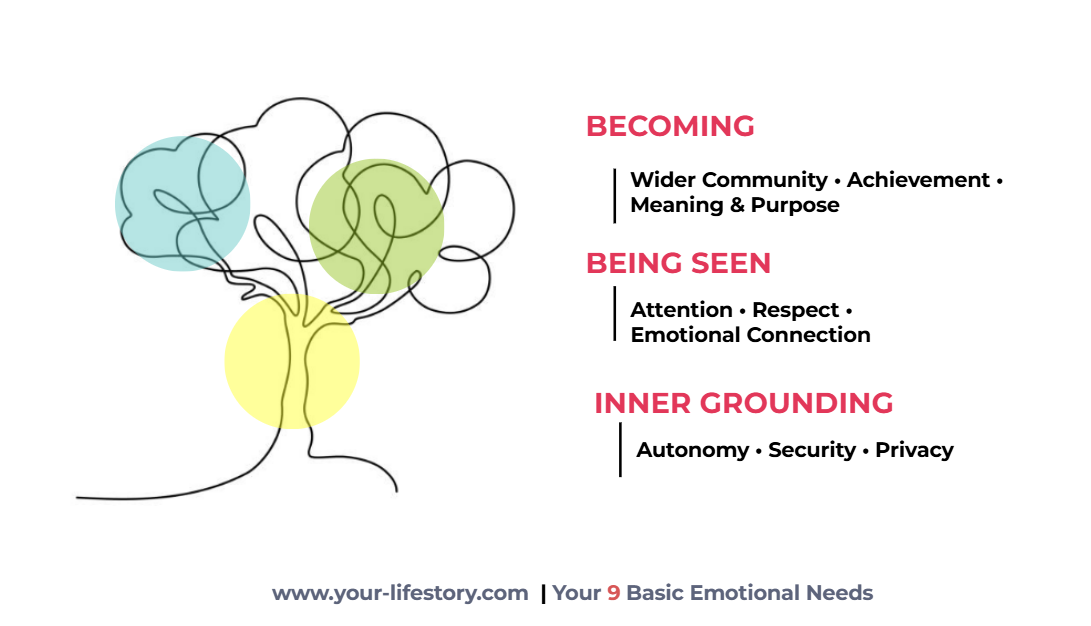
So here's a gentle check-in. Not a checklist. Not a diagnosis. Just nine quiet needs, grouped into three clusters, with one question each to help you listen to what your own life might be trying to tell you.
Cluster 1: Inner Grounding
These are the needs that help you feel at home in your own skin.
1.Autonomy & Control
The need to have a say in your own life — to make choices, express your views, and influence your direction rather than feeling constantly driven by demands and circumstances.
When it's missing: you feel trapped, frustrated, or emotionally drained. Small decisions feel heavy. You either grip too tightly or stop asserting yourself altogether.
A question to sit with: If I had more say in my own life, what would I change first — and how much of me have I lost keeping everyone else happy?
2.Security
The need to feel safe — physically, emotionally, psychologically. Not certainty. Just enough stability to relax, think clearly, and function without your nervous system running on high alert.
When it's missing: anxiety. Restlessness. Can't relax. That uneasy feeling even when nothing is actually wrong. Your nervous system stays on high alert — not because it's broken, but because it's trying to protect you. It just doesn't know when to stand down. Over time, you might try to create safety by controlling everything, pleasing everyone, or staying in situations that feel familiar but aren't good for you.
A question to sit with: What helps me feel even one percent safer right now — and can I give myself that today?
3.Privacy
The need for space and solitude. Not isolation — restoration. A quiet moment to process, recharge, and reconnect with yourself without interruption or expectation.
When it's missing: overwhelm, irritability, emotional burnout. Stress builds when there's no time to digest experience. You start to lose touch with your own needs and desires.
A question to sit with: When did I last give myself five minutes of true quiet — and what happened when I did?
Cluster 2: Being Seen
These are the needs that remind you that you matter.
4.Attention
The need to be seen, heard, and acknowledged as a whole person. It's both receiving and giving genuine attention — receiving nourishes the self, giving builds connection.
When it's missing: you feel invisible, overlooked, unappreciated. You might withdraw, overcompensate through perfectionism or people-pleasing, or stay so busy you don't have to feel it.
A question to sit with: Who do I give my real attention to — and who gives theirs to me?
5.Respect
The need to feel valued, recognized, and appreciated — not just for what you do, but for who you are. It's knowing your presence and contributions matter.
When it's missing: self-doubt, resentment, difficulty asserting yourself. You may feel unappreciated or struggle to recognize your own worth without outside validation.
A question to sit with: Do I respect myself — and when did I last feel genuinely appreciated?
6.Emotional Connection
The need to feel understood, supported, and genuinely close to others. Not just being around people — sharing your feelings and being met with empathy and acceptance.
When it's missing: loneliness creeps in, even in a crowd. You may crave intimacy yet push people away, or feel emotionally numb without knowing why.
A question to sit with: Who can I actually talk to — not small talk, but real talk?
Cluster 3: Becoming
These are the needs that give your life direction and texture.
7.Wider Community
The need to feel connected, accepted, and supported within a group. Not just relationships — belonging. A shared identity, trust, friendship.
When it's missing: loneliness, disconnection, rejection. Prolonged isolation increases stress and makes it harder to reach out for support.
A question to sit with: Where do I feel like I belong — and if I can't name a place, what might that tell me?
8.Competence & Achievement
The need to feel capable and effective — to experience progress and mastery in your skills and efforts. It's what builds confidence, self-esteem, and motivation.
When it's missing: frustration, stagnation, self-doubt. You feel like you're just getting by without growth or recognition. Burnout creeps in.
A question to sit with: What small win could I notice and celebrate today — not because it's impressive, but because it's mine?
9.Meaning & Purpose
The need to feel that your life matters — that what you do contributes to something larger than yourself.
When it's missing: emptiness, monotony, hopelessness. You question your value or direction. Sadness and fatigue settle in without a clear cause.
A question to sit with: If my life were a story, what would I want it to be about?
What Now? A Gentle Check-In
Awareness is the first step. Not fixing. Not optimizing. Just noticing.
Which of these needs feel most met right now? Which feel neglected — and how does that show up in your daily life? Are there patterns? Certain needs that are consistently ignored?
You don't have to solve everything today. You just have to start listening.
Pick one need. One small action. One honest conversation with yourself.
Nurturing your emotional needs isn't selfish. It's not needy. It's human. And it's the foundation of living a balanced, fulfilling life.
You're not broken. You're just hungry in places nobody taught you to name.
And now you know where to look.
If this resonates, I'd love to hear from you.